The city that once reigned as the locus of brute American manufacturing strength has been in collapse for decades. Yet now, in its deepest decline, Detroit is once again ripe for a new kind of development, as Urbanophile explains in an exceptional piece of internet journalism. What kind of craft revival could emerge from the recession-wrought wreckage of Motown?
Hat tip to Galen Pierce-Gardner and Sistah Sarah.


dream house, rough draft
One of our first Big Graduate School Projects is a residential design for Sustainable Building Design & Construction. We're supposed to incorporate everything we know about sustainable building into a house.
To make things more exciting I decided to design something I'd actually want to live in...when I win the lottery.
I learned Autodesk Revit 2010 for this project. It's a lot like Inventor, but this house still took a full day to draw this up, with plenty of help from my classmate Mike Hairston, and the model is rough.
Three bathrooms are clustered on the north side to accommodate a composting toilet system.
Of course there's greywater treatment, composting, rainwater catchment, maybe even a biogas digester to make methane from animal wastes.

Most exterior walls would be 6.5" polyurethane SIPs, R-40. Probably a SIP roof too.

From SE. Exterior glass is concentrated on the south wall, where it does the most good for passive solar heating.
The floor of the 2nd level is polished concrete, which has pretty good thermal mass properties. Not as good as water, but water is so much harder to walk on. Unless you're in the bible. But then you'd have bigger problems, like locusts. And whales.
Um, anyway, we're restricted to 1600 sq. ft. of living space...but there's no limit on shop space...so I added a 1600 sq. ft. shop in the basement.


The three bay doors would be these, R-value 17.5, with windows along the top for daylighting, and taller than shown here.
The shop is wired for a nice TIG rig. 220 volts on 30 amp breakers at least.
I'm leaning towards a rammed-earth shop floor on top of a concrete slab. From what I've heard, earthen floors are really comfortable. My feet hate concrete floors.
A separate ventilation system removes fumes and dust, preventing any nasties from mixing with the air in the living area. LEED is really particular about indoor air quality.


South elevation.


To make things more exciting I decided to design something I'd actually want to live in...when I win the lottery.
I learned Autodesk Revit 2010 for this project. It's a lot like Inventor, but this house still took a full day to draw this up, with plenty of help from my classmate Mike Hairston, and the model is rough.
Three bathrooms are clustered on the north side to accommodate a composting toilet system.
Of course there's greywater treatment, composting, rainwater catchment, maybe even a biogas digester to make methane from animal wastes.


The floor of the 2nd level is polished concrete, which has pretty good thermal mass properties. Not as good as water, but water is so much harder to walk on. Unless you're in the bible. But then you'd have bigger problems, like locusts. And whales.
Um, anyway, we're restricted to 1600 sq. ft. of living space...but there's no limit on shop space...so I added a 1600 sq. ft. shop in the basement.


The shop is wired for a nice TIG rig. 220 volts on 30 amp breakers at least.
I'm leaning towards a rammed-earth shop floor on top of a concrete slab. From what I've heard, earthen floors are really comfortable. My feet hate concrete floors.
A separate ventilation system removes fumes and dust, preventing any nasties from mixing with the air in the living area. LEED is really particular about indoor air quality.

East elevation. The north side is set into a modest hill, so the upstairs door and the shop bay doors are all on grade.

South elevation.

From SW, showing master bedroom. I haven't figured out the interior walls yet.

From SE.
Brazing Copper to Steel with Gasflux C-04 Nickel Bronze
While researching something else the other day, I came across a few people wondering how to join copper and steel. I had to do this once and had great success using this method, so much so that I've used it a few times since.
--
I use Gasflux C-04 nickel bronze in 3/32" diameter, along with their Type B blue paste flux. These should be available through Airgas on the East Coast. Low-fuming bronze from the local welding store is not at all the same thing.
Copper, being much more thermally conductive than steel, quickly sucks heat away from the joint. So if the copper you're brazing is connected to more copper, be prepared to heat up the whole mess, which can take a lot of heat.
Conversely, steel is slow to disperse heat, so you may want to preheat the steel to avoid overheating the copper, especially if there's a lot of steel and not so much copper. By the time the steel comes up to temp, the copper may be hot enough to flow brazing filler, just from being around the steel.
All that said, this is not a very hard joint to braze. If you've done blacksmithing or basic MIG or stick welding, this would be a lot easier to learn than TIG. A quick practice joint or two would suffice for training.
There are other ways to join copper and steel, like silver soldering, but this method may create a stronger joint than silver, especially in a tee or butt joint. Bronze fillers (like C-04) are better for filling gaps than silver fillers.
This method works especially well for brazing copper tube passing through a hole in sheet steel. The hole need not have a perfect clearance fit around the pipe, and the tube need not be perfectly centered in the hole.
As in all brazing operations, freshly-sanded, clean, oil-free parent metals are highly recommended.
If the copper gets too hot, it'll open up a hole, which would likely mean replacing the copper, so watch out for that.
Discoloration of the copper is normal and can be easily removed with abrasives like Scotch-Brite and emery roll.
Copper anneals at temperatures well below brazing temperatures. Be prepared for the copper to soften considerably.
I've always used oxy-acetylene, but oxy-propane would surely work.
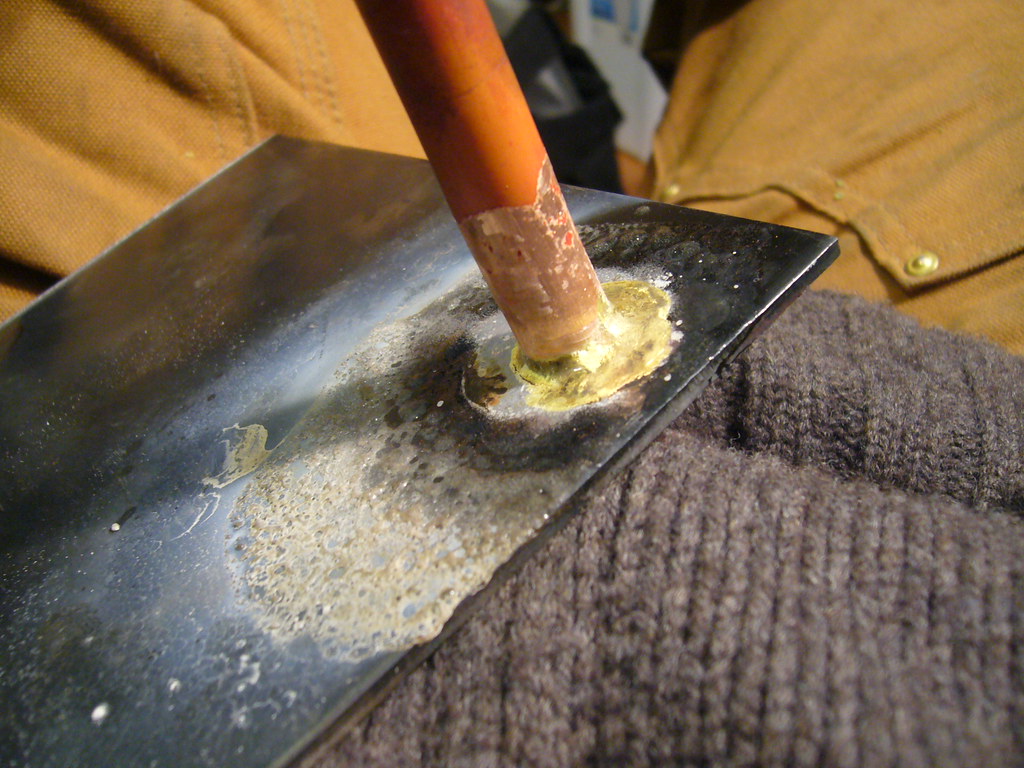
UPDATE: Here's an example.
 Not my absolute best work, but good enough. Flux was applied to the steel only in a small circle, hence the black oxidation everywhere.
--
I use Gasflux C-04 nickel bronze in 3/32" diameter, along with their Type B blue paste flux. These should be available through Airgas on the East Coast. Low-fuming bronze from the local welding store is not at all the same thing.
Copper, being much more thermally conductive than steel, quickly sucks heat away from the joint. So if the copper you're brazing is connected to more copper, be prepared to heat up the whole mess, which can take a lot of heat.
Conversely, steel is slow to disperse heat, so you may want to preheat the steel to avoid overheating the copper, especially if there's a lot of steel and not so much copper. By the time the steel comes up to temp, the copper may be hot enough to flow brazing filler, just from being around the steel.
All that said, this is not a very hard joint to braze. If you've done blacksmithing or basic MIG or stick welding, this would be a lot easier to learn than TIG. A quick practice joint or two would suffice for training.
There are other ways to join copper and steel, like silver soldering, but this method may create a stronger joint than silver, especially in a tee or butt joint. Bronze fillers (like C-04) are better for filling gaps than silver fillers.
This method works especially well for brazing copper tube passing through a hole in sheet steel. The hole need not have a perfect clearance fit around the pipe, and the tube need not be perfectly centered in the hole.
As in all brazing operations, freshly-sanded, clean, oil-free parent metals are highly recommended.
If the copper gets too hot, it'll open up a hole, which would likely mean replacing the copper, so watch out for that.
Discoloration of the copper is normal and can be easily removed with abrasives like Scotch-Brite and emery roll.
Copper anneals at temperatures well below brazing temperatures. Be prepared for the copper to soften considerably.
I've always used oxy-acetylene, but oxy-propane would surely work.
UPDATE: Here's an example.
Subscribe to:
Posts (Atom)

 Posts
Posts


