Showing posts with label best of. Show all posts

Recently read, currently reading, soon to read

The Adventures of Johnny Bunko, by Daniel Pink, in which a career advice book a la "What Color is Your Parachute" is interpreted via manga as a 20-minute read.  How long until every other genre is converted into Japanese comics?  Seriously, let me know--this is awesome.

Eco Barons, which is at its best when it's about people who made it big, cashed out, and bought up land for conservation, almost obsessively.  The guy who helped start the super-80s clothing brand Esprit now owns a good chunk of Patagonia and plans to turn it into a Chilean national park.  A good read, if occasionally preachy or wordy.  I probably won't finish it for a while.  Seems like only half of the people profiled are/were businesspeople, the most interesting group.

Green to Gold, which is inspiring in showing how large corporations are seeing conservation, efficiency, and renewable energy as competitive benefits rather than liabilities.  I just hope the remainder focuses on smaller businesses than BP, Sony, Dupont, and Dow.
Fun fact from the book: The proportion of venture funding invested in cleantech (US and Canada) went from <1% in 1999 to 9% in 2005.
Twenty-five cents of every VC dollar invested in 2009 went to cleantech (though this includes other regions, notably Europe and Israel, where cleantech is an even bigger deal).
2009 cleantech venture funding increased $1.5 billion over 2007.  You remember '07.  It was that year before the financial collapse.

Free Agent Nation, by Daniel Pink (again) which will hopefully be as good as this.  This guy was Al Gore's speechwriter?  Only Al Gore could make this guy's writing sound dull.  Zing?


Getting Green Done is a 2009 book by a ski resort sustainability director who used to install home insulation for a living.
Hmm...American dream...hard work...saving the Earth.  It's kinda like Captain Planet wrote a book.  Plus there's skiing.


Just a little green hair dye and a bath in blueberry juice and we've got ourselves a live-action remake.
Plus there's blueberries.

Brazing Copper to Steel with Gasflux C-04 Nickel Bronze

While researching something else the other day, I came across a few people wondering how to join copper and steel.  I had to do this once and had great success using this method, so much so that I've used it a few times since.

--

I use Gasflux C-04 nickel bronze in 3/32" diameter, along with their Type B blue paste flux. These should be available through Airgas on the East Coast. Low-fuming bronze from the local welding store is not at all the same thing.

Copper, being much more thermally conductive than steel, quickly sucks heat away from the joint. So if the copper you're brazing is connected to more copper, be prepared to heat up the whole mess, which can take a lot of heat.

Conversely, steel is slow to disperse heat, so you may want to preheat the steel to avoid overheating the copper, especially if there's a lot of steel and not so much copper. By the time the steel comes up to temp, the copper may be hot enough to flow brazing filler, just from being around the steel.

All that said, this is not a very hard joint to braze. If you've done blacksmithing or basic MIG or stick welding, this would be a lot easier to learn than TIG.  A quick practice joint or two would suffice for training.

There are other ways to join copper and steel, like silver soldering, but this method may create a stronger joint than silver, especially in a tee or butt joint. Bronze fillers (like C-04) are better for filling gaps than silver fillers.

This method works especially well for brazing copper tube passing through a hole in sheet steel. The hole need not have a perfect clearance fit around the pipe, and the tube need not be perfectly centered in the hole.

As in all brazing operations, freshly-sanded, clean, oil-free parent metals are highly recommended.

If the copper gets too hot, it'll open up a hole, which would likely mean replacing the copper, so watch out for that.

Discoloration of the copper is normal and can be easily removed with abrasives like Scotch-Brite and emery roll.

Copper anneals at temperatures well below brazing temperatures.  Be prepared for the copper to soften considerably.

I've always used oxy-acetylene, but oxy-propane would surely work.

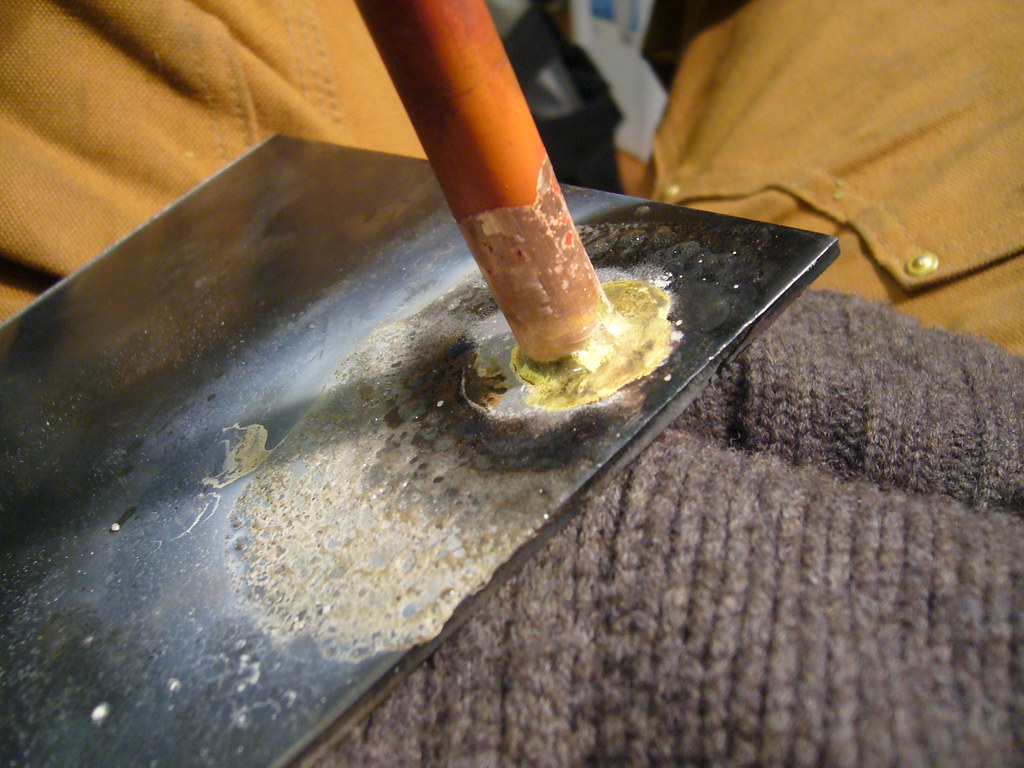
UPDATE: Here's an example.

Not my absolute best work, but good enough.  Flux was applied to the steel only in a small circle, hence the black oxidation everywhere.

What Obama Could Say to Students

Later today, the President will make a "Back to School" speech to America's K-12 students. The White House released the text of his remarks earlier.

The speech mentions several careers to which students might aspire:
Maybe you could be a good writer – maybe even good enough to write a book or articles in a newspaper – but you might not know it until you write a paper for your English class. Maybe you could be an innovator or an inventor – maybe even good enough to come up with the next iPhone or a new medicine or vaccine – but you might not know it until you do a project for your science class. Maybe you could be a mayor or a Senator or a Supreme Court Justice, but you might not know that until you join student government or the debate team.
And no matter what you want to do with your life – I guarantee that you’ll need an education to do it. You want to be a doctor, or a teacher, or a police officer? You want to be a nurse or an architect, a lawyer or a member of our military? You’re going to need a good education for every single one of those careers. You can’t drop out of school and just drop into a good job. You’ve got to work for it and train for it and learn for it. [Emphasis mine.]
Generally, a fine message. But it doesn't jive with Obama's desire to reinvigorate the American manufacturing sector. In naming Ron Bloom as his senior counselor on manufacturing policy on Monday, he said Bloom is "going to help us craft the policies that will create the next generation of great manufacturing jobs." [Emphasis mine.]

What about the next generation of great manufacturing workers? Tomorrow's machinists, carpenters, welders?

As it turns out, welders are in short supply in this country. The American Welding Society reports the average age of American welders is in the mid-fifties. AWS anticipates a potential shortage of 200,000 welders by 2010. That figure excludes self-employed welders.

Compare this with the oft-reported nursing shortage, which a recent Johns Hopkins Magazine article reports is gone but will return soon. According to a nursing professor at Vanderbilt, the average American nurse is 43.8 years old. Buerhaus predicts a shortage of 260,000 nurses by 2025.
The average welder is more than 10 years older than the average nurse, and we'll need more welders sooner.

In fact, few of the careers Obama mentions are among those in short supply. In May 2009, Manpower, Inc. released the results of its fourth annual Talent Shortage Survey.

The top 10 jobs American employers are having difficulty filling:
1. Engineers
2. Nurses
3. Skilled Trades*
4. Teachers
5. Sales Representatives
6. Technicians
7. Drivers
8. IT Staff
9. Laborers
10. Machinists/Machine Operators

Worldwide, it's a similar picture:
1. Skilled Trades*
2. Sales Representatives
3. Technicians (primarily production/operations, engineering or maintenance)
4. Engineers
5. Management/Executives
6. Accounting & Finance Staff
7. Laborers
8. Production Operators
9. Secretaries, PAs, Administrative Assistants & Office Support Staff
10. Drivers

* Manpower notes:
In this survey, Skilled Trades refers to a broad range of job titles that require workers to possess specialized skills, traditionally learned over a period of time as an apprentice. Examples of skilled trades jobs are: electricians, bricklayers, carpenters, cabinetmakers, masons, plumbers, welders, etc.
Of course Obama is right to encourage students to follow the careers they're drawn to. And I don't expect him to mention only the jobs that are in high demand amongst employers.

But Obama is missing an opportunity. He could have started to remove the stigmas that help shroud manufacturing careers from today's brightest students: that training in the trades is "just something to fall back on"; that welding is dirty work, unfit for an educated young person; that there's no future in being a plumber or an electrician.

Obama says students will need the "problem-solving skills [they] learn in science and math to cure diseases like cancer and AIDS". He could have also mentioned the problem-solving skills required to, say, plumb a house, or diagnose engine trouble.

There's much work to be done to revive the manufacturing sector, especially small manufacturers. Expanding the MEP would be a great start.

But if this is to be "a country where things are made" in the next twenty years, I hope it's today's kids who'll be doing the making.

Don't Panic.

I arrived in the mountain town of Boone, North Carolina, five days ago, my little red pickup Baby loaded down with everything I'd need to start a new Official Graduate Student life here.

Then the kick-ass housing situation I'd been counting on fell through.

Don't panic. Meet grad students, sleep on their couches, join couchsurfing.org, buy beer for your hospitable hosts. When the couches run out, decide to go camping at the last minute. Keep looking for the right place to live. DON'T PANIC.

--

Yesterday I was in class with a lot of uncertainties. We're writing a proposal for my university to compete in a Big Important Prestigious-As-Hell Competition. The rulebook is an inch thick. We have almost no idea how we're going to get the proposal done in time.

As I am wont to do, I kept raising problems I could foresee. How are we gonna transport this thing a thousand miles without damaging it? How much of the fabrication will we do in-house? Finally one of the profs said something to the effect of, "Don't panic about that. We'll figure that out."

--

I realized that every job is subject to these tensions. Do we make it ourselves or outsource it? What tolerance can we get away with here? Do we build it to last for generations, or just to last long enough?

Some part of me has been hoping that these issues would disappear one day. That eventually budget would cease to be a concern, so I could stop worrying about how much things would cost and just focus on how it's made.

But these things never go away. Everything costs something. The job is to deal with these factors, these tensions, without panicking.

Life Flux

Guatemala photos here

Many stories to tell.
The project I was lined up for was more engineering-y than my background and skillset. I worked on it a little, and spent a lot of time making various things. I talked safety, I talked about what tools to buy next, I got the flu, I fixed things, etc. Actually I was sick a lot of the time. Thank the sweet lord for antibiotics.
Climbed the Pacaya volcano in my last week there. Went to Lago Atitlan a couple days. Only a few days in Antigua...it was nice but it gets old quick.
A great experience, all in all. But I am a lot less idealistic about being able to make a career doing that kind of work. Seems like everyone involved is a volunteer, more or less.

The plan was to treat my time in Guatemala as a 'field internship' to earn the last credits of my undergraduate degree. This worked, somehow, and now I'm a few days from graduating with a VCU Bachelor's of Interdisciplinary Studies degree (concentration in Appropriate Technology)
.....and after only 12 years and 27 institutions...... *

So, now what?

The plan is to earn an M.S. in Technology with a concentration in Appropriate Technology from Appalachian State University in Boone, NC. This is the only 'AT' graduate program in the country, to my knowledge. Through the Academic Common Market, I am an in-state student, tuition-wise, even though I'm from Virginia. And they have a nice 50s-era Department of Technology building, with what appear to be well-equipped wood and metal shops. They were a big factor, perhaps not surprisingly.

Earlier in the summer, I was working on a really cool prototype of a fuel cell system for a small start-up in Richmond. Great place to work, and I was doing some fun/challenging 3-D solid modeling in AutoCAD Inventor. I was ready to take a more permanent position, defer my grad school admission, and stay on for the fall or longer. They were down, but the money wasn't there to pay me.

So grad school it is. I move to Boone on Saturday.
Eventually I suppose I have to end my career as a professional student. But not yet.

*actually more like 6 years and 5 colleges

A thought on safety

Tools
are like guns
and are ideally treated as such.

Now I'm talking about guns used in a certain way, like by a gun collector or a hunter. I'm not a big fan of guns, but if there must exist guns, I'd prefer they all get treated the way these guys treat their guns.
And I'm talking about tools like a plasma cutter, an oxy-acetylene torch, that kinda real powerful high-energy kinda tool. Well, all tools, but those especially.

That kinda tool can mess you up right good and real quick, if you don't handle it right. You could die because of being just a little bit wrong.
On the other hand, you treat the tool with respect, you take care of it, you can go your life using it every day and be just fine. In fact, there's lots of people doing it.

And--big bonus compared to guns--it's a lot less likely someone is going to pick up a plasma cutter and threaten your life with it. You control these tools your own damn self. Any problems, you usually got just yourself to blame.

This is scary to a lot of people. It's a big responsibility. It takes courage to know that this thing in your hand could hurt you real bad, and then to go ahead and use it anyways.

Occupational reconsideration. Or: Shoe shopping

More often than not I find bloggable moments happening in the insomniac quietude of 3am.

--

Here's how it goes.
I get into a thing.
Waiting tables.
Photography.
Building bikes.
I do the thing for a while.
I start to think about what it would be like to do this thing forever.
I try to envision all the good parts, the bad parts, the dull moments in between those parts.
I try it on like I'm trying on a pair of shoes.
I walk around in it for a while.

And then something happens.
The shoes aren't quite right.
The fit isn't there.
The color doesn't work with my wardrobe.
So I take off the shoes, put them back in the box, and look for the next pair.

Right now I'm unlacing a pair that I thought was gonna work.
It's sad.
But I relish the process, as all-consuming and pitfall-fraught as it is.
I get better at it every go-round.

It's harder every time though.
Every time I think: No, I finally got it right this time.
But I'm always wrong about that.

--

I see myself prototyping. It has its own subtle art. It's in demand, it's interdisciplinary, it's challenging, it means using a lot of the stuff I know a little too much about.

Great blurb from Diego Rodriguez about prototyping (more here):
As you make a prototype, assume you are right and everyone else is wrong.
When you share your prototype, assume you are wrong and everyone else is right.

What I've been doing, what I am doing, is prototyping a career for myself. And prototyping is a long, complicated, expensive, failure-ridden process.

Que haces alli en AIDG?

Soy hombre de taller
Soy technico
Soy soldador
Soy disenador
Soy maquinista
Soy metalista
Soy mechanico

--

What do you do at AIDG?

I'm a man of the shop
I'm a technologist
I'm a welder
I'm a designer
I'm a machinist
I'm a metalworker
I'm a mechanic

...but, these days, the Spanish words seem to convey more meaning

To be "an operator"

There is a story about one of my relatives that has been going around my family (in various exaggerated forms) since the 40s.

The protagonist is a great-uncle of mine. The setting, Europe at the end of the second world war.

My great-uncle had been fighting for the Allies. With the war over, he wanted to return to his family's ancestral home, a tiny village in Czechoslovakia (at the time), near Ukraine. He didn't know how much of his family had survived the war, but he wanted to bring as many as he could back to the US with him.

There were some obstacles. My great-uncle was in France. The village lay deep in Soviet territory, and the Soviets weren't keen on American passers-by. Border crossings lay ahead. The cold war was beginning. Europe was in shambles.

Somehow he acquired a jeep and some gasoline. Frankly, he probably stole the jeep. He drove the jeep across Europe. He spoke the languages. He made deals. The Soviet border guards drank well.

He found the village and married the only surviving female relative, then turned the jeep around to bring her to the US. They lived in California the rest of their lives.

--

I've known this story forever. It's part of what I am.
My great-uncle, he's what we call an operator. He speaks every language. He's undaunted by uncertainty. He thrives where others fear to operate. He doesn't follow the rules. He does the impossible. He has a toolbox a mile deep.

Why Bikes are a Great Way to Learn About Technology

It goes like this. Someone finds out that I'm a "bike guy". They learn that I build up bikes for friends, or they see bike tools in my apartment, or they read this blog.

Sometimes they figure that bikes are all I want to work with, all I'm interested in, just bikes.
The reality is almost exactly the opposite. In learning about bikes, I've learned a lot about other things. Because of what I know about bikes, I know a little about a lot of other related things.

Bikes are a great way to learn about technology. They're accessible, but they're challenging enough to be interesting. Getting started is easy, but learning the finer points of bikes means learning about all kinds of technology.

- Industry standards for bicycle parts are a mixed bag, to put it mildly. Pick up a random bike part, and its threads might be based on a metric, an imperial (SAE), or a totally bike-specific standard. Some parts are ISO, some JIS; Raleigh even had its own threading standards. Then there's the Italian, French, and Swiss standards. A few parts are left-hand threaded. People who know bikes are comfortable switching between all these crazy standards. Inch vs. metric? Try Italian vs. Swiss. Pop quiz: What's the difference between ISO and JIS bottom bracket axle tapers? Ask Sheldon

- Many of the essential technologies of modern life are present in every bike. Bearings, chain drive, brakes, control cables, and spoked wheels, to name a few. People who know bikes are familiar with all these subsidiary techs that drive so many other things. They've taken apart bearings, regreased, and reassembled.

- For under $300, you can buy a set of tools that will allow you to maintain damn near any bike. That kit doesn't have everything (notably a truing stand and workstand). But good luck overhauling your motorcycle with $300 in tools.

- Similarly, information about bike repair is easy to find. http://www.sheldonbrown.com/ is 90% of what you need.

- Steel bike frames are pretty unique in the realm of steel fabrication. The tubes are thin-wall--down to .3 mm in some cases. They can be joined in a lot of different ways, each requiring advanced skills. A frame needs to be straight, so low-distortion joining is key. The frame has to interface with all those funky bike part standards mentioned above. And the frame has to fit the rider, so there's a big human-machine-interface problem to be solved. Building bike frames is challenging, but part of the reward is that most other fabrication jobs are straightforward in comparison.

- Weight is always a factor with bikes. As Keith Bontrager said:
Strong. Light. Cheap. Pick two.
This isn't just true for bikes, though. As designers and fabricators, bike people are acutely aware of the trade-offs inherent in working within these constraints.

- There are bike parts made from a wide variety of materials, from brass to carbon fiber. Bike people have experience with the interactions between these materials. They know that aluminum seatposts tend to get stuck in steel frames because of galvanic corrosion.  They know that blue Loctite or beeswax can keep a threaded part from coming loose.

Why else?

Been Standing on the Corner of 5th and Vermouth

I went down to the local watering hole in the wee hours to get quarters for laundry.
I saw police lights outside while waiting at the bar, so when I walked out I looked around and saw a cop pulling over either:

A) Chrysler's last-ditch effort at the electric car

or

B) a golf cart with weather flaps

Upon closer inspection it turned out to be B. Three young men were crammed inside. From the way they were pulled over it was clear they'd been "driving" on Harrison St. As I walked by, the cop and the guy in the driver's seat were going around and around:

cop: I can tell you've been drinking. Don't lie to me now.

"driver": Naw, man, c'mon, I'm telling you, I ain't been drinkin, man...listen, I had A drink, but I'm good man, I'm tellin' you, I'm good, listen!

cop: Look, I know you've been drinking.

et cetera

His two buddies in the back seat were looking around like, "Oh. Shit. This was a really bad idea."


So, you decided to go joy-riding on city streets in a golf cart with weather flaps at 1 am. And you probably stole the golf cart.
Fine. Everyone's been there at some point. Sucks you got caught.

But now you claim you were not drunk when you hatched this plan?
Good day, sir. Good day.


Plumbing 55-gal. Plastic Barrels for Water Storage

Why Barrels?
- common waste product
- may be available free
- strong, lightweight, durable, good on water quality


Several types of barrels
removable top/"open-top"
- can be re-used in many ways (compost turner?)
- rarer around here
- more expensive to buy new

"Closed top" barrels
- used fo the design below
- more common
- cheaper to buy new
- fewer re-use possibilities besides liquid storage
- no removable lid, just two threaded holes:


The best barrels for water storage have only held food products, like cola syrup, grain/baking supplies, juices, sauces, animal feed?


On the other hand, this design calls for many PVC joints (see below), meaning many fittings and much time spent fitting them. The price of the PVC fittings may greatly exceed the cost of the barrels. The time required to plumb more than a few barrels may be prohibitive. Fortunately, the design is fully scalable, all the way down to a single barrel.

This system is intended to be connected to a house gutter to provide rainwater storage, ultimately feeding an irrigation system for a garden plot.

On Bungs
Closed-top barrels usually have two threaded holes, one coarse-threaded, the other fine-threaded.

Coarse thread hole/"bung"
- funky threading: buttress threads
- but: bung cap has an adapter for 3/4" NPT

Fine thread bung
- regular 2" NPT female threads

Bung caps are made to accept a bung wrench for opening and closing
You can buy one or you can make one.
A pair of pliers will work in a pinch.

Barrel Support
Weight of water is an important consideration.
Water weighs eight pounds per gallon.
A full 55-gal barrel weighs more than 440 pounds.
Some barrel system designs require the construction of a sturdy timber frame for stacking the barrels. This is a fine idea if you have the necessary time, resources, and expertise. I do not.

Instead: stacked barrels in a pyramid--cheaper, faster to construct, more mobile, less resource-consumptive than timber frame.


- Avoid crushing empty barrels. Full barrels shouldn't sit on top of empty ones.
- Prevent the barrels from rolling away when full. Wire rope wrapped around the barrels like a giant rubber band might work
- Prevent the barrels from blowing away in the wind when empty.
- The higher the barrels are, the greater the pressure at the outlet. Might want to make a base from something sturdy. For more, see this.

Plumbing the Barrels

Scale up/down to suit.

One feature of this design: the nominal distance between any two connected bungs is ~23 inches (diameter of one barrel).

Why is This "Untested"?

We found a local source for IBCs at $20 each, cheaper than plumbing the comparable number of barrels. (2 IBCs = ~600 gallons for $40).
We've had a hard time finding suitable barrels for free in the Richmond area.
Faster to install 2 IBCs than 10 barrels.
But, I couldn't find anything on the intertubes about this.

Related Reading
Art Ludwig, Water Storage: Tanks, Cisterns, Aquifers, and Ponds
Stacy Pettigrew and Scott Kellogg, Toolbox for Sustainable City Living: A Do-it-Ourselves Guide

Shop Skills I Possess

Know-how and good sense are the shibboleths of the shop; they are inadequately conveyed in writing. But here goes.

Notes

- I'm a designer, prototyper, troubleshooter, and problem-solver.
- I love designing and fabricating one-off solutions to complex problems.
- I love teaching to interested students.
- I learn new skills quickly.
- Steel is my favorite material.  Aluminum, copper, brass, and hardwoods are nice, too.  I know little about plastics and composites.

Introductory Level

Small gas engine maintenance and repair
Automobile maintenance
Oxy-acetylene welding
CNC machining

Some Experience
Stick welding
Advanced machining (e.g. lathe-cut threads, high-precision work)
Sheet metal work (bending brake, shear)
Blacksmithing/forging steel
Epoxies (wood, metal, plastics)
Tube bending, especially thin-wall steel
Fine woodworking
Table saw (wood)
Wood and metal finishing

Lots of Experience
TIG welding
MIG welding
Brazing steel, with brass or silver filler
Copper pipe (cutting, sweating, brazing to steel)
Basic machining (turning and milling)
Drilling and tapping
Horizontal and vertical band saws (wood and metal)
Power sanders, grinders, chop saws, miter saws
Precision layout and measurement to .001 inch or .1 mm
Bicycle maintenance, repair, assembly
Bondo (applying, shaping)
AutoCAD (2D)
AutoCAD Inventor (parametric solid modeling)

Relevant Coursework:
Welding Techniques, Caldwell Community College, Boone, NC
Computer-Aided Drafting II, J. Sargent Reynolds Community College, Richmond, VA
Small Gasoline Engines, J. Sargent Reynolds Community College, Richmond, VA
Machine Shop Practices, John Tyler Community College, Richmond, VA

Machine Blueprint Reading, John Tyler Community College, Richmond, VA
Intro to Digital Drafting, Corcoran College of Art + Design, Washington, DC
Furniture Fundamentals, Corcoran College of Art + Design, Washington, DC

Relevant Work History
Graduate Assistant, Department of Technology, Appalachian State University, Boone, NC
Volunteer, Appropriate Infrastructure Development Group, Quetzaltenango, Guatemala
Technical Consultant, MARZ Industries, Richmond, VA
Journeyman Framebuilder, Tektonics Design Group, Richmond, VA
Student Shop Foreman, Machine Shop, School of Engineering, Virginia Commonwealth University, Richmond, VA
President and Co-Founder, Bike Fabricators at VCU, Richmond, VA
Shop Assistant, CNK Machine Manufacturing, Richmond, VA
Intern, Fabrication and Model Shop units, Office of Exhibits Central, Smithsonian Institution, Washington, DC
Lab Technician, Sculpture Department, Corcoran College of Art + Design, Washington, DC

On Obscurity

I was at a vintage bike show last year, chatting with a talented framebuilder whose star is rising. I had bought a t-shirt from him earlier, so I mentioned before we parted ways that I was glad to have expanded my collection of obscure frame company t-shirts*.
From the look on his face it was clear he took my comment a little differently than I'd intended it. Perhaps it wasn't the best choice of words. But he was off with his family by the time I realized my fumble.

I wish I could have explained myself as well as Obama did in today's inauguration address:
Our journey has never been one of shortcuts or settling for less. It has not been the path for the faint-hearted — for those who prefer leisure over work, or seek only the pleasures of riches and fame. Rather, it has been the risk-takers, the doers, the makers of things — some celebrated but more often men and women obscure in their labor, who have carried us up the long, rugged path towards prosperity and freedom.
He described better than I can most framebuilders I've come to know. They are doers, makers of things, uninterested in riches and fame. They are obscure but they are kick-ass. Their obscurity is not a liability.  I meant it as a compliment.

This is the kind of person that I strive to be: someone who goes out and gets stuff done and doesn't make a whole lot of noise about it.

*which includes, among others:
Signal
Rebolledo
Courage
Bilenky
Pereira

Why the Shop

I spend a lot of time in a shop. I consider myself a shop person.  But most of the people in my life are not shop people, with only a few exceptions.

I often think about how to relate to non-shop people about the shop. "Why do you spend so much damn time down there?", they ask. "You always come home filthy." "What's so exciting about screw threading of all things?"  "What's the point of endlessly tinkering?"

It's especially difficult to discuss, perhaps, because the shop is not generally a place I go to accomplish a specific thing. I might go there to work on one problem but end up working on the shop itself. Sometimes the tool I need is broken, so I spend an afternoon making a new one, or fixing the old one. The work is often non-linear; I work on what needs to be worked on.

Not many places are ambiguous in this way. A kitchen is for cooking; a classroom is for learning; a theater is for seeing shows. A shop can be for doing anything, and its purpose can change momentarily.  A shop is for working on things, but that includes the shop itself and everything in it.

Working in a shop can have a wonderfully self-reflexive feeling, of constantly re-examining the tools, the process, the shop--even the people in the shop, including yourself.

A shop is a place where all variables are in flux. A mill, for example, is so versatile that it could be used to produce a copy of itself*. When you're standing in front of a mill, the question is not "What is possible?" but now "What do I want to do?".
In the shop, the only limitation is you. It's up to you to decide what deserves your time and effort. It's a nice metaphor for growing up.

But why machine tools and screw threads and such?  What dispassionate things to study and to have strong opinions about.

There's a feeling I get after I've been using a lathe for a while. I don't mean any lathe, I mean one specific lathe, because each one is a little different. When I first start using it, I take my time flipping every lever, making sure I don't make some catastrophic mistake. But over time the lathe and I come to an understanding. I learn her idiosyncrasies, and she lets me know when I'm pushing her too far. After a few weeks, I'm flipping levers left and right. I know every control without taking an eye off the workpiece. I like to use the words sensual and intimate in describing this feeling. It's a little like raising a dog.

My old machining teacher liked to refer to using a machine tool like driving a car, e.g. "How do I drive this daggone mill?".  For my part I think of it more like flying an airplane.  It's more complicated than driving a car, but the possibilities are greater.  Pilots are an elite, sometimes cocky bunch, much like machinists.  Among those in the know, what they do inspires awe.

Machine tools are anything but cold. It honors me to include myself in a tradition that bears the mark of so many great people, including a few of my ancestors. It brings me closer to a history I don't fully understand yet. It gives me something in common with everyone who's ever made something well.

It's by learning to apply tools well that we have advanced our human condition. Our survival depends on knowing how to manipulate our world with tools, and on continuing to pass on that knowledge.

And by the way:
Besides being essential to everything we do, screw threads are, in one sense, a culmination of all human experiences. Their development is the result of many tiny decisions made by many people over many centuries. The most recent decisions were based on older decisions, which were based on yet older ones. That legacy goes back to the earliest humans. And without exaggerating, it can be said that screw threading standards have made fortunes and lost them.

In fact, every modern tool is a permutation of some simple, primitive tool. It was when we first started using these simple tools that we became technological--that we began a period of ever-increasing improvement upon what came before.

*This is theoretically true, but it's not something that happens often. It would require almost fantastical quantities of metal and time.  Some of the tools used to make machine tools are friggin' huge.

How Not to Sell Wine

Girl at the Whole Foods wine desk last night:
"This is really good--it got, like, 90 points!"

Oh! Wow! 90 points! I like how you didn't even tell me who gave it 90 points.
Cuz that's what I was worried about--the number. I dragged my ass out here to Glen Allen so I could buy pricey organic sulfite-free wine based on what some magazine thinks of it. Y'know, cuz wine is purely a status symbol, not something I'd drink to enjoy. I'm sniffing, sipping, and scrutinizing the tastes you're pouring out of that $20,000 machine--but it's all for show. Thank you for finally telling me the damn number so I can get out of here. I hate wine.

Buying wine based on a number is like dating a girl with a big chest based on her bra size. It's a number just for show. The wine thing is actually worse--it's subjective.

Blogwise Blog on Blogging Bloggily


In response to a recent [Frame] thread on the pros and cons of a website vs. a blog for the framebuilding set...

- You need both, ideally. They can serve two different purposes and two different sets of clients.

- As has been discussed, there's a chasm of difference between writing a blog and writing a blog *for money* (or as part of a larger business plan/marketing strategy).
Doing it without involving money is great. I write this having failed at a meager attempt to turn blogging about framebuilding into a money-making proposition. It's more enjoyable this way, and anyway, about 30 people a week keep coming back for more.

- What one is doing by having an 'internet presence' is building a name for oneself, not selling bike frames. The Flickr, the blog, participation on the [Frame] list--none of it needs to be (directly) about making a buck. It's about building a brand for oneself, which is in turn part of making a buck. See, I'm building my brand right now, just by typing this, and I'm not even trying to sell anybody anything (yet).

In business school terms:
- A strong brand creates a competitive advantage that is wholly inimitable. No one but Jon Q. Builder can produce a "Jon Q. Builder" frame, because the value of the frame is tied to the reputation of the maker.
- Even, say, Wal-Mart* doesn't have such a good competitive advantage, because, with enough money and resources, anyone could copy Wal-Mart's business plan.  In contrast, a "Jon Q." is inherently more valuable than a non-"Jon Q.", even if the latter is cheaper or has a shorter lead time.
- The brand and the presence are assets with real dollar values (although calculating the exact values is a different story). If Jon Q.'s web presence is competitive, then it will be a stable asset.

- The world of professional art is full of people who understand how to gracefully cultivate a brand. Besides that, it's loads of white wine.

- Richard Sachs is the prime example of a 'presence'. Go see how often he posts to his Flickr. Jonny Cycles also comes to mind, ever since he got that fancy digital-camera-direct-Flickr-uploader thingy.

- There is a staggering quantity of framebuilding-related web content being produced. It's impossible to keep up with. There's easily a couple hundred blogs and Flickr streams. I'd bet that number has at least doubled in the 2.5 years I've been on this list. Don't get scared, though. Just figure out what you can offer that nobody else can.

All this is part of why the post about Chris Zanotti has been removed.

On Grinder Safety

Here was the most interesting part of my day (so far):

I work as a 'Student Shop Foreman' in the machine shop of an engineering school.
A guy came in today who's been in pretty regularly in the few weeks I've been working here. He cut up some stainless sheet on the vertical band saw. No big deal.
Then he wanted to use the grinder to remove the burrs.
The only utility grinder we have is monstrous, like 12" wheels.
Sure, I say, just be careful 'cuz that thing can take your hand off.
So I walk away. And before he's even really gotten started, the plate gets snagged and wedges between the grinder support and the grinding wheel. Turned out the gap was set too big. Coulda happened to anybody.
All of us who had been chatting gathered around to watch the grinder spin down, partly out of curiosity, partly out of concern that the situation not get any more interesting.
And then he shows me his hand, which is bleeding from the thumb, cut pretty deep, but thankfully it was the burr that got him, not the grinding wheel.
First aid kit. Alochol wipes, sanitizing spray, gauze, bandages, anitbiotic ointment. Sink. Wash for a few minutes.
He's telling me about how he hates blood and needles and going to the doctor. He's pale in the face. Got him sitting down. He wants the trash can next to him. Turns down water but I send for some anyways.
At this point I'm running worst-case scenarios through my head while I keep pressure on his thumb. It's not a life-threatening cut, but if he passes out, things get more complicated. He could go into shock, and I don't remember exactly how to deal with shock (a blanket over them and call for an ambo maybe).
He ralphs into the trash for a couple minutes, while I change the gauze and maintain pressure. Then he picks his head up, color in his face now, he's back amongst the living, 100% fine.
That's one way to learn how to use a grinder.

Be careful, folks. Mind the grinder gap.

Consumers Are Consuming Raw Materials

Then in the middle of a "Manufacturing Processes" lecture, the prof said something about how, as opposed to manufacturers, consumers don't consume raw materials.

I perked right up. I'm a consumer, I thought to myself, and I consume raw materials all the time.

Moreover, the resurgence of craft in the US* has redefined what it means to be a consumer.

*
cf. MAKE magazine, steampunk, TechShop & The Crucible, hobbyist/amateur frame builders, this WIRED article mentioned previously, and even The Whole Earth Catalog

These "crafters 2.0" are consuming raw and semi-raw materials (as well as scrap materials, even better). They're a different kind of consumer.

It's a niche, but thanks to The Long Tail, it's a valuable niche.

--

This way of consuming smacks of a bygone age, when a family used what nature provided to produce what they needed to survive.

The settlers who populated the American frontier didn't head to Wal-Mart to stock the wagon on their way out of town. There was no all-inclusive, Chinese-made, Frontier-Settling Kit.

They processed the raw resources around them, and they used those resources completely, wasting little.

They manufactured on-site a lot of what they needed: a house, a plow, leather goods, clothing, food. Manufactured goods were expensive before mass production, so it was cheaper to make rather than buy.

Perhaps I'm being sentimental.

But I wonder what can be learned from these frontier ancestors. The best of them were tough, innovative, self-sufficient, and hard-working.

How to be an Academic in Five Easy Steps

1. At every opportunity, impress upon others the importance and relevance of your field of study. All other fields are inferior.

2. Remember that your field is connected to everything. It is a lens through which everything is to be viewed. Continuously look for ways in which you can connect your field to disparate events and ideas. (The conflict in Georgia? Caused by poor financial planning. Or a grave ethical problem. Whatever you're studying.)

3. Emphasize that your field is infinitely complex and far beyond the grasp of the average person. Practice saying this in the most condescending way possible: "I'd love to explain XYZ Theory, but the differential equations are a little over your head...I better not get into it."

4. Obviously, a PhD is necessary to even begin to understand. After all, if any schmuck could learn this stuff in a few minutes, then your PhD would be useless.

5. "It depends..." is the best answer to every question. The good academics stopped really answering questions many years ago.